Monday, February 18

South Fork Rod Company C9052.

Steeped in olde timey, bitches. 
In the fall, I decided I'd finally put the time and effort into making wet flies work. I've thrown myself into it, preferring them to all things (although I haven't tried them through a major hatch, yet, mostly because there haven't been any), but I've been assured that I should do so by someone who's opinion I trust.

Amongst things devoted to wet flies has been an interest in obtaining a rod to fish them correctly. At this time, I have little interest in the North Country, tight line method espoused by such notables as Oliver Edwards and Davy Wotton (a personal note to Mr. Wotton: Please consider a manicure before your next video. For the love of God, your nails are revolting, and since you're tying flies I'm forced to look at the disguisting things. Yes, this matters), but am much more focused on the more traditional cross stream methods most commonly associated (and derided) with wet fly fishing.

I tried a couple of rods to start, first a 10' TFO Jim Teeny 5wt (with a 6wt line), which turned up the myriad of shortcomings, both expected and not: Tight loops and high line speed are not ideal for wet fly fishing. You want to keep loops open to ensure your droppers don't tangle each other (which can be done somewhat by simply changing stroke), but the line speed issue is more or less integral to things due to the intrinsic power you put into a stiff rod. The thing I didn't know ahead of time is that fast line speed turns fuck ups into catastrophes, meaning if you tangle your line against itself in a bad cast, you're gonna end up cutting and retying alot. When your cast hits a branch, it tends to wrap itself tight, and you'll loose a lot more flies, whereas a slow rod allows your tangles to be unwound without constant recutting, and you can retrieve flies without having to clomp across the stream.

So, the Teeny was out, and a $20 eBay (including shipping!)  Silafex 022985 was in. We're closer, as its slower, fuller action seemed to prevent alot of the issues, but its basically a 6/7wt (emphasis on 7wt) rod, which is a bit too much for the small fish I frequent. I may have resolved the issues of a fast rod, but it was definitely overkill for the smaller waters I frequented.

Come the Somerset Fly Show, I met with Cameron from TFM, and mentioned what I'd been fishing. He suggested a rod I should try out, and said he'd send a loaner up my way.

Three weeks later, I came home to a surprise at my door.

Tuesday, January 1

Stewart's OTHER three flies.

The spider, a dubbed wet, and a hackled wet. This is all the direction
we were left with. 
Before you read this, realize I'm not a historian, an artist, or really very clued in. I just needed something to occupy my mind this extended weekend, and I decided this was something that I found relevant to my interests.

And, again, tied as I interperted the pattern descriptions with modern
materials.
What I'm getting at is if I'm wrong, fuck off, I followed the instructions in a 155 year old book. So, y'know, its pretty much open to interpertation. Deal with it. That aside, I'm not going to bother writing a biography of WC Stewart, because frankly all I'd do is plagiarize others, anyways. Its not like he's not a hugely pivotal figure in fly fishing, more or less advocating the use of the upstream wet fly, and helping push the spider technique of tying into the lime light.

So, whenever anyone really discusses Stewart, its all about the three spider patterns we were left with (black, red, and dun), but we were left with three additional patterns as well as these words:
The three following are the winged flies to which we are most partial... An immense number of killing flies may be made by varying the wings and body, but nothing is gained by extending he number beyond those just mentioned, and we do not believe six more killing imitations can be manufactured.
Now, he's referred to six flies, so its important to note the first three are his spiders. More interestingly, though, is that Stewart clearly believed in the appearance of life over strict imitation, and furthermore (as well documented), was so willing to put preference of technique and design over imitation, one of his famous spider descriptions (the dun) didn't even bother to note the thread colour.

Anyways, the short of it is that the guy was able to reduce his pattern collection to six, which is in stark contrast to guys who carry six different boxes of nymphs, alone. Maybe we can learn something? Let's look at all six patterns in turn...

I stole this for my own records, it ain't mine. Deal.

I admit, I'm lifting this wholly from another source. Its a bullshit move, and I'm a dick for doing it, but I'm doing it for my own personal records.

Someone has posted original scans of the feather plates from Leonard West's "The Natural Trout Fly and Its Imitation"(pg 73 through 91).

To you, Mike Conner, I say thank you, as well to the posting at the Fly Fishing in Maryland forum I lifted this from. I highly suggest the original post as Mike Conner, the poster, added many very helpful. personal notes that I don't feel is right to steal. The descriptions and plates are PD, but his information is not, please view it at its original site as long as its there.

Plates and annotation after the jump...

Wednesday, December 12

Your granddad's weird shit: Thompson Wing Former.

Not pictured: Sea King.
I don't know where I saw this thing first (actually, not true, but I'm not giving them the traffic), but I knew upon seeing it, I wanted it.

I love your old school wet flies. I bought Bergman's trout strictly to have access to plates upon plates of painted wet flies I knew I'd never actually be bothered to tie, and I enjoy trying to tie them. I also have a hard-on for stupid gadgets, so a press that would shit out perfectly formed quill slips?

Fuck yeah, Sea King.

And with that, I started on a quest for a D.H. Thompson Wing Former, so, I enlisted the help of fellow forum degenerates, and within a few weeks I had one winging its way to my door.

Wednesday, December 5

Flies of our Fathers

The "Hardhead." It looks "fishy." Don't you hate people who say that shit?
This is a delightful post about bullshit fly tying, an activity that should be confined to the winter when its generally too shitty to go outside, but if you want to go outside, lemme mention an "event" that a friend of mine, who does not have an ugly American flag coat, likes to have this thing he terms the "Eastern PA Flyfishing Tying [Event]." That's not actually what he calls it, but unless you're versed in idiocy, "jam" makes it sound gay.

And not the good sort of life-of-the-party, occasionally catty, usually well dressed fun to be around happy gay but the seedy van-in-a-parking-lot creepy gay that no one wants to think about.

Anyways, he's doing this for the second year and its mostly a byproduct of a "local" forum getting together and shit. Not unlike that flag jacket guy thing, there'll be lots of assholes tying shit, but its not a trade show or a sell shit event, the format is geared towards the idea that a newbie will show up and learn, even though its basically a bunch of guys from said forum sitting around in a room. Y'know, tying flies. And shit. FWIW, its nice to put a face to your Internet nemesis once in awhile.  Read more, if you want (or not, that's the same link as before), or fuck off... Y'know, whatever.

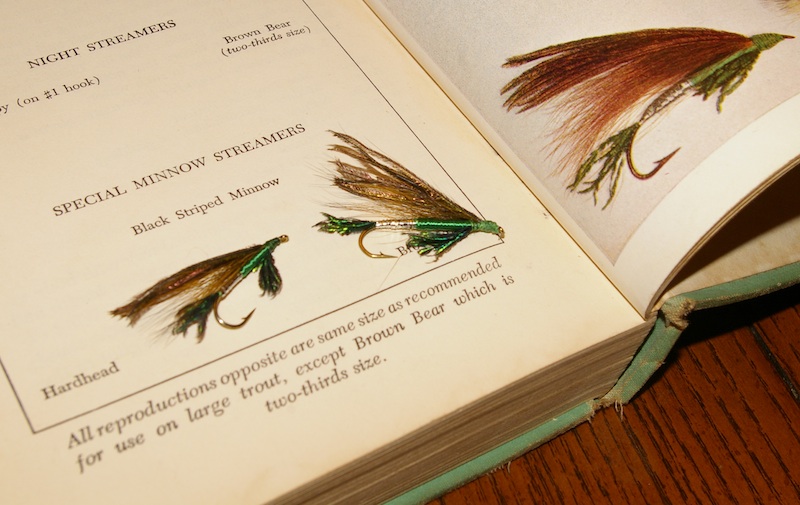
Anyways, Awhile back, I was killing time in a used bookstore when I came across  a copy of Taking Larger Trout (pub 1950) by Larry Koller for $2.

Being a fan of old shit, and books with meticulously hand drawn colour plates (can someone explain the difference between a plate and a picture, besides classiness of term?), I bought it and promptly stuck it on a shelf and forgot about it.

This weekend, I found a really striking, and forgotten, fly in the back pages of it, the Hardhead.

A fly so striking I was immediately taken by it, and promptly tied, the shimmering swords and contrast in body materials came across immediately in print, that even if I never catch anything on it, I had to at least take an interest in making it.